
WWI and Mental Health: The Case of Thomas F. Meehan

On July 3, 1936, the body of Thomas F. Meehan (1881-1936) was found inside a tool shed at his Lower Gwynedd home. A coroner confirmed the cause of death was suicide with a bullet through his head. He was mentally deranged when he took the bullet. It was also confirmed that Thomas had been in "ill health," and suffered a nervous condition due to wounds and gas infection when he fought in World War I.
Fighting in a war lead to veterans experiencing trauma and PTSD from the devastation faced in front of their eyes. Not many people knew how to fix this, hence calling this the "silent wound."
Who Was Thomas F. Meehan?
Thomas was born in Cambridge, MD on August 27. He moved to Philadelphia at a young age, and then joined the First Pennsylvania Infantry where he was promoted to major. He worked in different companies in the Philadelphia area until landing the job at the chemical manufacturing company James Good, Inc. where he was promoted to president of the company. When America got involved in World War I, Thomas was drafted, became chief of staff, and then promoted to Lieutenant Colonel of the 78th Division American Expeditionary Forces.
Fun Fact # 1: His brother Edward was a commander of the 109th Division during World War I and was awarded the Distinguished Service Cross.
Thomas was the president of the Pennsylvania Department of Reserve Officers Association of the United States. In 1932, he campaigned against the PA House subcommittee's passing of the reduction of the army appropriations, calling it a "false economy."
"This bill not only completely ignores all war department budget recommendations, but drastically cuts the present number of officers and enlisted men of both regular army and National Guard, and also entirely eliminates all summer training of reserves components by subterfuge 'postponement,' All this, under guise of economy, so-called, with no reckoning of the sure penalty and ultimate high cost of lives and blood of untrained manpower. Such vicious false economy may well be questioned, from mere replacement standpoint, if others of more immediate concern were not present. Forceful, immediate action must supplement what has already been done to insure prompt defeat of this vicious threat."
- Thomas F. Meehan's speech, February 4, 1932
NOTE: You can read his personal account of being part of the 78th Division by clicking on the button BELOW:
"So, after carrying out their almost hopeless (ask with superb ardor and fortitude, these exhausted men of the 78th in the gas saturated Bois des Loges were, on the night of October 1!), told they were to fall back to the Grandpre-St. Juvin road, abreast of the line of the 82nd Division, and they complained. They might be staggering with fatigue and nearly suffocated with gas but they had been fighting in hot blood at close quarters for that portion of the woods. They did not want to yield this dearly bought ground They were critical of the order which compelled them to retrace their steps in the darkness - which was done in good order — across the levels that had been spattered with blood of their comrades."
- Thomas F. Meehan on the Meuse-Argonne Offensive

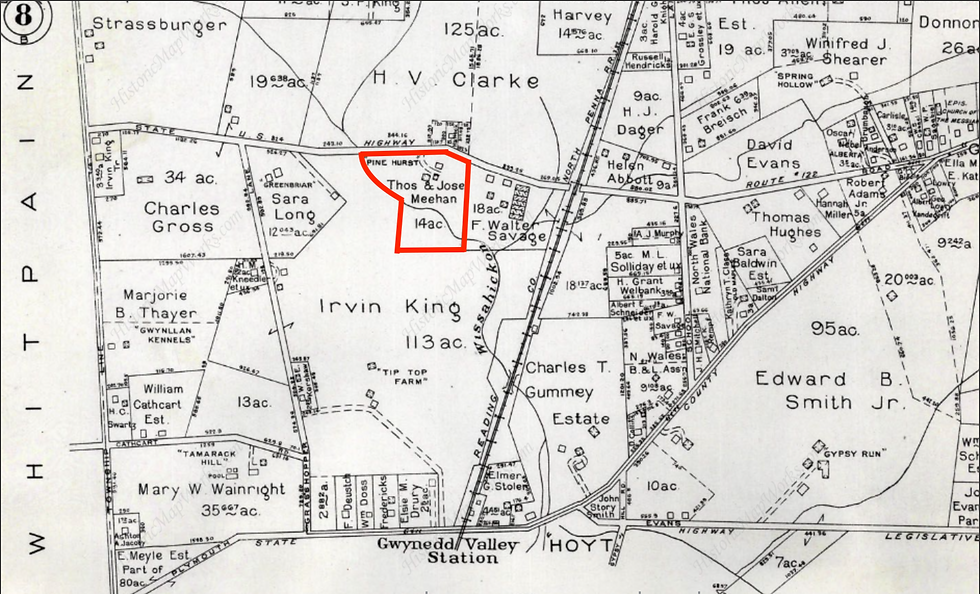
After serving in the war, Thomas and his family settled in Lower Gwynedd in the spring 1924, according to the MontCo Recorder of Deeds. Before he came to Lower Gwynedd, there were previous owners who owned the Pinehurst property. Thomas purchased the property from Oliver P. Snowden (1892-1967), and he took over the property after UPenn lecturer Robert M. Smith (1854-1919) took his own life with a bullet. The property was taken over by his wife Ann.


The Silent Wounds of World War I
Thomas along with other WWI veterans felt the effects of the war that left so much destruction and impact on them. From learning in my history classes, the trenches were the most talked about topic when discussing World War I. It was where the war mostly took place. With the poisoned gas, the bombs, and the many soldiers killed in front of their eyes would make a veteran feel scared for the rest of their lives.
"During the war, the phrase 'shell shock' was developed to characterize the psychological effects of these encounters. At first, it was assumed that the artillery shell blasts had physically injured the nerves. But it didn’t take long to realize that the illness was far more complicated. Soon, veterans were exhibiting symptoms like extreme anxiety, tremors, nightmares, and an inability to perform daily tasks."
- Danny Mills,
"The Silent Wounds: Long-Term Mental Health Effects on WWI Veterans"
The term "shell shock" back then is known today as post-traumatic stress disorder (PTSD), but this was not treated properly. Instead, it was frequently misdiagnosed and stigmatized. Veterans who showed signs of "shell shock" was called a coward or even a liar. They were even put into solitary confinement and electric therapy. This didn't help any soldier at all. It only made things worse.
It was unknown how Thomas was feeling after WWI ended, but if he was experiencing "shell shock," he would've gotten anxiety or depression while trying to readjust to normal life. He would've experienced flashbacks and nightmares from the war. Since this type of mental heath was not properly treated, there might be negative affects within their families. There might be strained relationships or domestic violence.
Aftermath
Two years before his death, Thomas left a will for his family to split his estate for initially $25,000 and up. The value of his estate changed within a few months after his death: it went up to $46,758, then finally at $153,569.89. His wife would get half of the value; his brothers have 1/10; and his daughter Mabel would have 4/5 in trust.


Bibliography
"Gwyneddite Fights Army Fund Cut." Ambler Gazette. February 4, 1932. Page 6. https://digitalarchives.powerlibrary.org/papd/islandora/object/papd%3Awivp-gazett_18439.
Meehan, Thomas F. History of the Seventy-eighth division in the World War, 1917-18-19. (New York: Dodd, Mead and Company, 1921).
Mills, Danny. "The Silent Wounds: Long-Term Mental Health Effects On WWI Veterans." Doughboy Foundation. Last modified July 24, 2024. https://doughboy.org/the-silent-wounds-long-term-mental-health-effects-on-wwi-veterans/.
"NEVER BEFORE PUBLISHED PHOTOS: THE LIGHTNING DIVISION IN THE GREAT WAR." Ghosts of the Battlefield. Last modified December 3, 2025. https://www.ghostsofthebattlefield.org/restoration/never-before-published-photos-the-lightning-division-in-the-great-war.
"Robert Meade Smith a Suicide." Ambler Gazette. July 3, 1919. Page 1. https://digitalarchives.powerlibrary.org/papd/islandora/object/papd%3Awivp-gazett_10916.
"Soldier's Burial For Gwynedd Man." Ambler Gazette. July 9, 1936. Page 5. https://digitalarchives.powerlibrary.org/papd/islandora/object/papd%3Awivp-gazett_23660.


Comments